
"What Do You Do?"
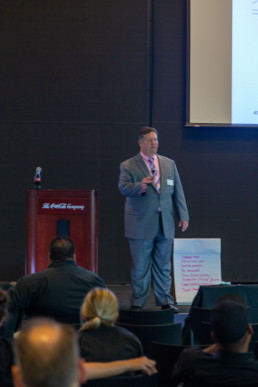
Not long ago I was on stage for a keynote presentation for Subway Development. We reached a point in the presentation where I asked,
“What do you do?”
From the very back of the room a lonely voice I could barely hear said,
“I manage a Subway.”
I said, “What does that mean?”
She said, “Well what do you think it means?”
To which I said, “Ah, yes, you’re right! If you let me decide what it means it could mean anything! Let me rephrase the question.”
“What should I think it means?”
And she said, “Well, I’ve never thought about that before.”
Have you considered what it means to do what you do? It is a question that deserves some careful consideration. And how we answer this key question will determine not only what others think of what we do, but what we think of what we do as well.
Our work reflects who we are. It is the essence of what we think of ourselves. Adults in their 40’s and 50’s working entry level positions have a different opinion of themselves than do those of the same age in corporate positions who leave to start a business.
This is an area that deserves deep thought and contemplation. And just like my friend in the back of the room at the Subway meeting, very few people give it any thought at all.
That’s why I was there, to help them understand they must determine what they do, what their employees do, and why they do it. After working with them for over four years I helped them come up with this statement:
“I manage a unit for an international company that is the worlds largest franchise.”
Is it true? You bet. Does it sound like more than I manage a Subway. Darn straight.
And it means more to the person saying it than the person hearing it. Every time she says this, she’s reminded she’s a part of something much bigger than the task at hand.
That realization changes the way she serves the client, represents the company, and ultimately, thinks of herself.
She has an obligation to the whole. Her little part of the world just became a whole lot bigger, more important, essential.
She’s a part of something far more important than she thought. An international company is depending on her.
Perhaps you don’t work for a large organization. Maybe you’re a solopreneur. Still, have you considered,
“What do you do?”
Spend time considering the impact you have. There are clients and their families, vendors, the greater community, and of course your friends and family that are depending on you.
You are far more vital to the whole than you’ve considered. Give yourself the credit you deserve when answering, “What do you do?”


What Entrepreneurs and Small Business Leaders Can Learn from the Demise of Sports Illustrated
What went wrong at Sports Illustrated?
Last week it was announced that the publishing licensee of Sports Illustrated (SI) had missed a payment to their licensor resulting in termination of the agreement and ultimately laying off the entire Sports Illustrated staff. What happened?
For decades, sports stars and youth dreamed of the day they would end up in SI. It was the gold standard of sports reporting, and the coveted cover of the annual swimsuit issue was anticipated by millions.
But like so many other iconic brands and publications, SI may now be on the scrap heap for many reasons.
We can speculate the impact of attempts to conform to new social norms and thereby alienation of the avid SI reader. But that would only be minimal. The real target of any magazine is not the reader, but the aggregation of a group of target clients for the advertisers.
SI’s failure to embrace new media, their sluggish response to create a compelling website, their failure to focus more on reporting in depth stories that couldn’t be covered in a 24-hour news cycle, coupled with a declining interest in print media all led to this result.
Ultimately, Sports Illustrated failed to react quickly to changes in the market and how information was delivered. Any other reason is merely additional fuel to the fire that already existed.
Some will say they lost their way. From the first swimsuit issue through transgender cover models, the common complaint would be, “What did any of that have to do with sports?”
All these apparent deviations from sports reporting are merely symptoms of a brand that failed to recognize that in the span of 70 years of the publication, interest in sports and more specifically the lives sportsmen and sportswomen have changed.
And so has the way the reader consumes it and the advertisers targeting those readers.
Entrepreneurs and small business owners can learn a great deal from this demise if they’ll focus on the overall cause and not the symptoms that resulted.
This is a common failure of small business: We tend to look at symptoms and fail to trace the cause. We believe slow sales are caused by lack of selling, only to ignore the shift in our market that we’ve yet to react to.
So, here are a few take aways from the demise of Sports Illustrated.
- If you find yourself saying, “That’s the way we’ve always done it”, it’s time to make some changes.
- If you find you team not seeking new ways to do their work, it’s time to hire new people.
- If you find declining sales, don’t react radically, but react.
- If you find you’re not attracting new clients, it’s time to change your marketing.
- If you notice new clients aren’t like the old ones, you need to survey your new and old clients to find out why.
- If you don’t find yourself stunned by changes in your market, you need to pay more attention to your market.
- If you find yourself making changes that may alienate your core client, you need to determine if the change is proactive or reactive.
- If a change you are making is reactive, you need to focus more on the future of your market and company.
- If you see changes happening and find yourself saying, “That’s not going to last”, consider changing your mind.
- If you find yourself blaming the situation, you need to find your company a new leader.
Change is happening all the time. It’s the leader’s job to watch for it, anticipate it, and react to it before change forces a reaction.
Who Do You Spend the Most Time With?
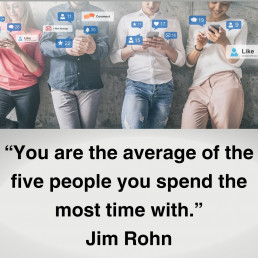
"You are the average of the five people you spend the most time with." This quote by Jim Rohn changed my life. No doubt it has changed the lives of countless people. While we can debate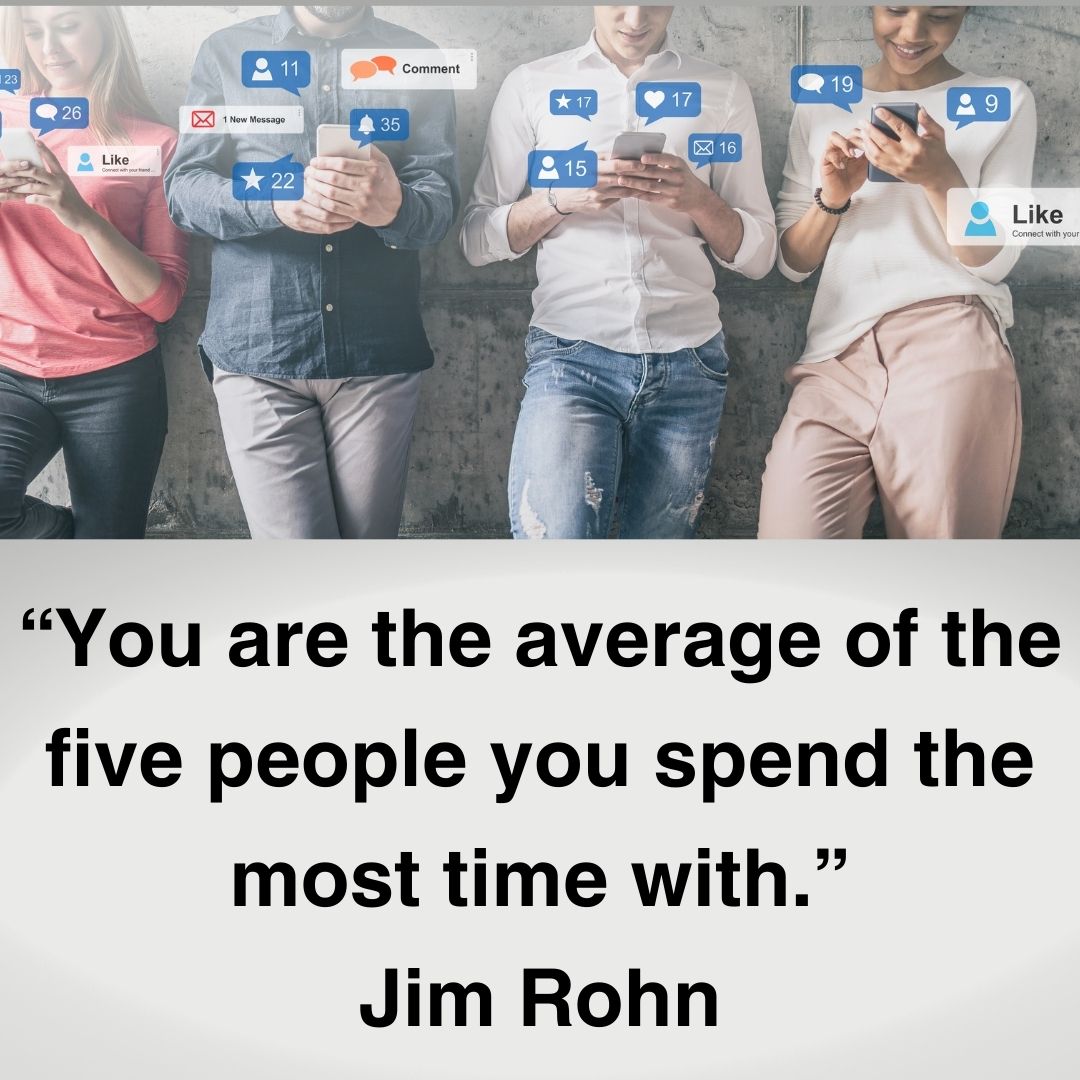 the source of the comment, there is little debate of the impact the thought put into action can have.
But do you know who you spend the most time with?
Spend Time With Jim Rohn and Other Masters HERE on Audible
According to Statista.com, the average internet user spends 151 minutes per day on social media channels. That’s more than 2 and ½ hours a day, nearly a full day of waking hours per week!

Time spent on social media channels is often filled with negative news, messages, and divisive comments and banter. What's more, time spent here is often taken from those we would otherwise spend time with in person.
Even when we're together, often we find ourselves embedded in our electronic world. This influences us in many ways, mostly negative.
When we do find positive messages, they often create envy and jealousy. We compare our blooper reel with everyone else's highlight reel.
This often impacts our self image resulting in negative thoughts and feelings. We spend the most time with ourselves. If you're hearing and seeing negative messages all day, it will be challenging to have positive comments and conversations with yourself.
Could we improve our inner circle simply by improving the conversations we have with ourselves? Of course. Since man obtained language it has been recorded that we’ve used repetitious language, chants, songs, and sentences to remind ourselves of things we desire to see in our lives.
Improve Your Inner Circle and Surround Yourself With New Ideas - Listen on Audible now for free!
How’s your self-talk? Not just what you verbally say, but what you think as well? Simply using your thoughts and words proactively can and will improve your life. And it will lead you to choose a better circle of "friends".
Most people love social media. I do too. But let's augment our electronic "friends" by listening to motivational, informational, and inspirational ideas.
Improve your life by improving the calibre of ideas and people you listen to. I've been doing it by listening to Audible for years. You can too!

The Brilliance of Westin’s Gear Lending
I like to believe we’re like most people. We try to take a vacation once a year, and a couple of times a year we get away for a weekend.
We used to stay exclusively in IHG hotels (e.g. Holiday Inn). I’ve been a member of their Priority Club (now IHG Rewards Club) since its inception in 1983. From Holiday Inn Express to Intercontinental Hotels, we’ve stayed in a lot of IHG properties. And we’ve generally enjoyed the experience.
Recently we’ve found ourselves staying at Westin Hotels. I’m not sure when it began but over the past year, we’ve stayed almost exclusively at Starwood Hotels (and mostly at Westin Hotels).
You may have heard by now that Westin Hotels have a workout gear lending program at their hotels. Westin is encouraging you to “Pack Light, Stay Fit”. They also run ads promoting their “Eat Well SuperFoods RX menus”.
I’m an avid runner, and I really enjoy running in cities I visit when on vacation. And because I’m on vacation, I usually indulge in foods I wouldn’t normally at home. To find a healthy food oasis at my hotel is a real treat.
This is a brilliant positioning and marketing move by Westin. While I’m not likely to take them up on their gear lending program, and I’m more likely to enjoy a Peameal Sandwich in Toronto than a superfood salad, the mere fact that they are available tells me that Westin understands me and my needs.
But that’s not all. Because they focus on what’s important to me in my everyday life, I expect they’ll understand my needs better than the average hotel when I travel.
Best of all, I know because they’re focused on people like me, I’m likely to find people like me at their hotels. And who doesn’t want to be with people like me?
Westin launched their “Six Pillars of Well-Being” for guests and employees in 2014. Do you think perhaps that their employees not only understand me but also are likely to me like me? You bet.
This is a wonderful example of a corporate valuable corporate initiative. Westin has immersed their culture in healthy living. Their employees benefit, their guests benefit, and you can bet their investors benefit.
Oh, and by-the-way, you simply must try the aptly named “Heavenly Bed”. You may not want to come home.
So, here’s the call to action for you and your business. What can you do that will make it clear to your clients and prospects that you understand their needs, and that because you do better than anyone else, they’ll feel likely to find people like themselves when they visit your business?
This should be your focus. You’ll attract employees who will be just like your offering. You’ll attract clients who will be just like your employees. And when we find ourselves around people just like us, we find ourselves more than satisfied.
Believe me, the rest will take care of itself.

New Client? Avoid This Major Misstep
Does your business have a way for new clients to sign up or request service without speaking to you or your staff personally? You should.
We’ve entered a wonderful new world in client recruitment. Clients today can research, review, and ultimately choose a new vendor for products and services (including yours) without ever talking with you or your staff. It’s a beautiful thing to turn on your computer or pick up your mobile device and find new clients requesting service.
But, because they have signed up without our help, we’ll likely make a big mistake the first time we interact with them. It’s the same mistake salespeople make all the time that creates confusion in the mind of a prospect and ultimately kills the sale. We want to tell them everything we think they should know about our product or service.
In the past, salespeople would keep telling about features and benefits long after a client had decided to buy, only to find their zest for their product or service has killed the enthusiasm of the client in making a buying decision. Having missed the obvious “I’m ready to buy” moment, the salesperson kept talking and lost the sale.
How do we do this today when clients tell us, “I’m ready to buy” online? We keep talking and do everything we can to keep them talking too.
Here’s what it looks like. A client places an order or service request. We reply through email or text thanking them for the order (appropriate to be certain) and then we add something more. Sometimes it’s a little more about the product or service than the client needs to know to buy but we feel they need to know in order to get full enjoyment or value.
What we’ve forgotten is the client decides what full value or enjoyment is, not us. And, because the client has decided without our help, our help is a distraction to their satisfaction.
But, the most obvious killer of the joy of purchasing your product or service without our help comes in the form of a question. It’s the worst possible question.
“Do you have any questions?”
Ugh! Now we’ve placed uncertainty in the mind of the client and in their decision to buy. If they had a question they likely found the answer through their own research. And if they didn’t find the answer they most assuredly would ask if it would determine a purchase or not.
Let’s say I’ve just signed up for your service and you’ve asked me if I have any questions. Since I’ve never experienced your service, I’ll assume you know more about your service than I do. I’ll assume I should have a question for you since you are asking me if I have one. I’ll wonder, “What am I missing?”
Maybe you know something I don’t know. In the absence of any real question I may have, I’ll likely ask if there are any specials or discounts I don’t know about. And now, you’re on defense. Defending your product and price and in the process devaluing it to the one person who had decided it was worth the money to buy it.
Whatever you do, don’t ask someone who has already made an intelligent purchase in their mind, “Do you have any questions.” Trust me, they don’t.