

⏰ Daylight Savings Time Might Be the Best Business Reminder of the Year
⏰ Daylight Savings Time Might Be the Best Business Reminder of the Year
Every year people complain about daylight savings time.
“We lose an hour of sleep.”
“It’s inconvenient.”
“The kids are standing at the bus stop in the dark.”
I get it.
But I see something different.
To me, daylight savings time is a signal.
It’s the signal that winter is ending and spring is coming.
Longer days. More light. New growth.
And for business owners and entrepreneurs, that reminder matters.
Because let’s be honest…
Many of the goals we set back in January have already faded.
The excitement of the new year has worn off.
The grind of business has taken over.
But daylight savings time reminds us of something powerful:
Everything renews.
The seasons renew.
The days grow longer.
Flowers bloom again.
And so can you.
Your business can reset.
Your goals can restart.
Your energy can return.
For me, Easter reinforces that message of renewal. But even before Easter arrives, daylight savings time whispers the same truth:
New beginnings are always possible.
So instead of complaining about losing an hour…
Take it as a reminder that hope, growth, and opportunity are right around the corner.
And maybe this is the perfect time to start again.
👉 If you're ready to turn fresh energy into real business growth, I’d love to help.
I work with entrepreneurs and chamber members to turn networking into a predictable sales system.
Send me a message or comment “RENEW” and I’ll share a few simple strategies that can help you make your next meeting a Million Dollar Meeting.

Seeing Satan: Signs of a Breakthrough
I'll admit it. I've been struggling lately.
Being an entrepreneur, business owner, employer, and speaker is challenging. And that's just my work life. Being an attentive and effective husband, father, friend, cat, dog, and bird servant is even more challenging. All while still not letting the dream of my next marathon die. Whew!
In the past I had things pretty well in hand. I had the right people in place, I had been doing what I was doing for a good long while. My days were pretty predictable. Plenty of time in the morning to workout, run, listen, write, record, and develop a positive baseline for the day.
Now, not so much. I never understood those people who said, "Life got in the way" but I do now.
Over the past few months though, I've begun to see a glimmer of the past. I've had a number of speaking engagements this year, I've been active in my professional associations and served on boards, and every now and then I'll take a morning and work on something completely of my own.
That was today, again. And again, it happened.
My dear friend Harvey Keil used to say, "If you're not running into Satan on a daily basis, you're probably running with him." Well, Satan, I see you!
It seems that each time I've tried to move forward the past few months, something has gone terribly wrong to derail my progress. Today, it's dysfunction with a few of my employees at one of my businesses.
I've all but finished a project I've been thinking about, studying, surveying, and researching for several months today and at a crucial point I am called in to solve a dispute between employees that easily could have been solved by themselves.
And I'm reminded that this is a good sign.
How many times have you worked to a good cause, nearly finished, only to see Satan appear and derail your progress? Maybe for you it's the political environment, the economy, the strife in society, the loss of a job, or just boredom in what you've been experiencing lately.
Could it be a sign that you're about to have a breakthrough? Could it mean that you are about to make a big shift, a massive move that will propel you, your loved ones, your friends, and clients forward in such a way that everything changes for the better?
I'm betting the appearance of Satan is evidence that you are (and I am).
Now, don't let the reference to Satan derail you, especially those of you who are non-believers. Just take Satan as a metaphor for whatever you believe works against you. See your desire to discredit this warning as evidence it applies to you too.
So, I see you Satan and that's a good thing. It's always best to know where the distractions and detractors are. That way you can avoid them. Keep moving. Great things are happening.

What Big Brands Can Teach Us - Know Your Customer
If you're in business you know doubt know why grocery stores place high-impulse items in the checkout line. Whether it's your child or the child inside each of us, big profits are made by selling candies, mints, snacks, magazines, sodas, and yes, gum as an add-on to your order.
I can remember the thrill of having my own money and spending it on bubblegum in the checkout line as a youth. My mother and our circumstances taught me at a young age there's an advantage to having your own money and the independence to spend it on whatever you choose.
So, I've always had a thing about the checkout line. I guess you'd say it's where I first remember making my own purchase. I loved baseball cards and the bubblegum that came inside them. I loved gum. Clove, Juicy Fruit, Fruit Stripe, Teaberry, you name a gum and I probably bought a lot of it.
But bubblegum was always a favorite until I "grew up".
Which is what caught my eye in the checkout line recently. Gum has gotten really expensive! I used to buy a pack for twenty-five cents. Now it's four dollars or more.
And then I saw the difference in marketing and pricing. As you see in the picture, the "bubblegum" is fifty cents less expensive than the "mint" gum.
That got me thinking. Who is likely to purchase each item? Wouldn't a younger person be more likely to be attracted to the bubblegum and the adults to the mint gum? That's when I realized the big brands price according to the target market of each item. An adult will spend more money on gum than a child will.
But there's really more here. First, children do not go to the grocery store with their parents as often as they did in the past. So it's less likely a parent has to listen to the whining of a child wanting bubblegum. What's more, this bubblegum is actually bubble-mint. Is it a gateway gum from sweet gum as a child to mint gum as an adult? Or is it targeted at adults who secretly want to indulge in their childhood joy?
The lesson is that you must consider your target market and their ability to purchase your brand or variation of product when setting a price. And of course you need to be certain there is a market for what you're selling.
By the way, I tried bubble-mint. And it's not bad. But fifty-cents less isn't going to get me to go back. Perhaps I need to find a pouch of Big League Chew.

Happy New Year! The Benefits of Observing a Fiscal Year
Happy New Year! The Benefits of Observing a Fiscal Year.
A fiscal year is a year in time observed by a person, group, or agency that may or may not coincide with a calendar year. A calendar year is generally January 1 through December 31. A fiscal year may star on any date and end one year later on the date just before the beginning date.
Have you ever wondered why some companies and nearly all governmental agencies observe a fiscal year that is not the same as the calendar year? What benefit could be attained by such practice?
Many governments, corporations, and non-profits benefit from observing a fiscal year by choosing dates that match cycles in their operations. For example, the United States government observes a fiscal year that starts on October 1 and ends on September 30. This matches the collection of funds, requests for funding and the creation of a budget (as if our government bothers with that these days).
Non-profits may similarly have a fiscal year that matches the timing of grant awards. Corporations may have fiscal years that match accounting practices, cycles in business, or the date the organization was formed.
A fiscal year is observed so that the organization may benefit from a different year starting date than January 1.
I'm not suggesting you change your fiscal year to July 1, unless of course that provides some benefit that you are missing. If so, check with your accountant (I am not providing any professional accounting advice). Then what does this mean for you and your business?
Simply put, the year is now half over (assuming you follow the calendar year). Is it time to metaphorically close out the books on the past six months, twelve months, or some other time frame? Has your business gone through a challenging few months that would best be put aside and "closed out"? Have you?
Or have you enjoyed a successful campaign for the past few months, or half year?
Whether it's time to celebrate success or close out a less than stellar performance, July 1 is the ideal time to do it.
Reflect on the past six months. Identify the wins and celebrate. Segregate the losses and adjust.
Now is the perfect time to reflect for a moment, and then to begin anew. And that can happen any day of the year.
Follow for more ideas on how to improve your business and your life @SpeakerGlenGould
"What Do You Do?"
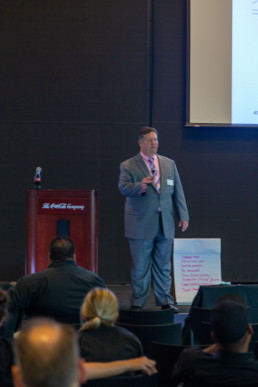
Not long ago I was on stage for a keynote presentation for Subway Development. We reached a point in the presentation where I asked,
“What do you do?”
From the very back of the room a lonely voice I could barely hear said,
“I manage a Subway.”
I said, “What does that mean?”
She said, “Well what do you think it means?”
To which I said, “Ah, yes, you’re right! If you let me decide what it means it could mean anything! Let me rephrase the question.”
“What should I think it means?”
And she said, “Well, I’ve never thought about that before.”
Have you considered what it means to do what you do? It is a question that deserves some careful consideration. And how we answer this key question will determine not only what others think of what we do, but what we think of what we do as well.
Our work reflects who we are. It is the essence of what we think of ourselves. Adults in their 40’s and 50’s working entry level positions have a different opinion of themselves than do those of the same age in corporate positions who leave to start a business.
This is an area that deserves deep thought and contemplation. And just like my friend in the back of the room at the Subway meeting, very few people give it any thought at all.
That’s why I was there, to help them understand they must determine what they do, what their employees do, and why they do it. After working with them for over four years I helped them come up with this statement:
“I manage a unit for an international company that is the worlds largest franchise.”
Is it true? You bet. Does it sound like more than I manage a Subway. Darn straight.
And it means more to the person saying it than the person hearing it. Every time she says this, she’s reminded she’s a part of something much bigger than the task at hand.
That realization changes the way she serves the client, represents the company, and ultimately, thinks of herself.
She has an obligation to the whole. Her little part of the world just became a whole lot bigger, more important, essential.
She’s a part of something far more important than she thought. An international company is depending on her.
Perhaps you don’t work for a large organization. Maybe you’re a solopreneur. Still, have you considered,
“What do you do?”
Spend time considering the impact you have. There are clients and their families, vendors, the greater community, and of course your friends and family that are depending on you.
You are far more vital to the whole than you’ve considered. Give yourself the credit you deserve when answering, “What do you do?”